
Speaker Measurements
CLIO Analysis — February 2026
About These Measurements
These are gated measurements — a time window isolates the speaker's direct sound before room reflections reach the microphone, yielding anechoic-quality data without requiring an anechoic chamber. The tradeoff is frequency resolution: the short gate window (~4ms) cannot resolve wavelengths below approximately 200Hz, which is why the frequency response plots begin there. Low-frequency behavior is characterized separately via near-field techniques.
On-Axis Frequency Response
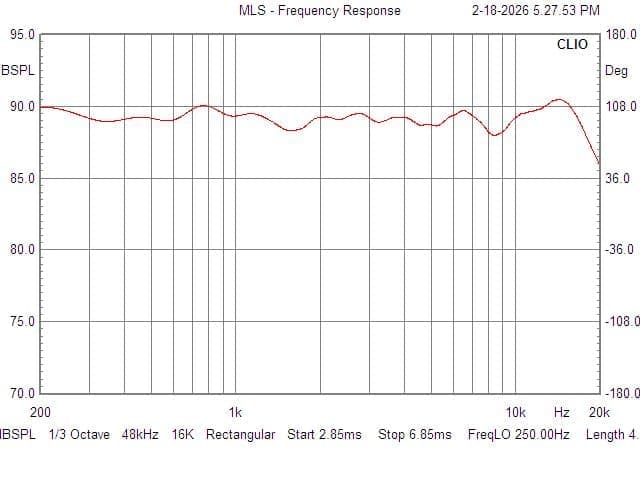
Plot 1 — On Axis
MLS frequency response measured on-axis at 1 meter. 1/3 octave smoothing, 48kHz sample rate. Flat response from 200Hz to 15kHz with gentle rolloff above.
Even from the midrange through the top — no shout, no hole.
Off-Axis Dispersion
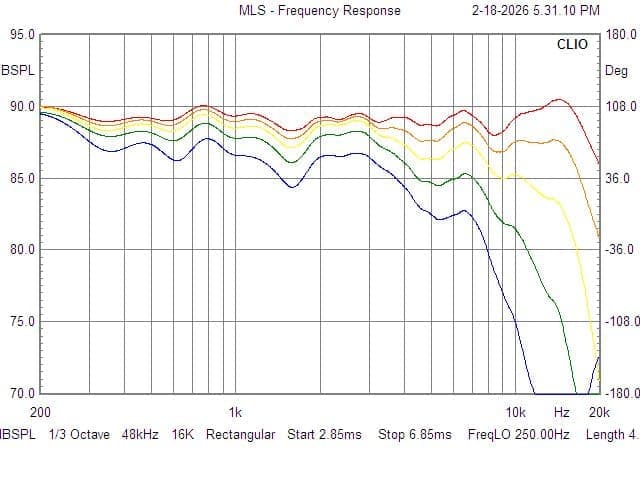
Plot 2 — Horizontal Off-Axis
Horizontal dispersion family at multiple off-axis angles. Shows controlled narrowing at high frequencies with smooth power response.
The image holds when you slide off the center seat.
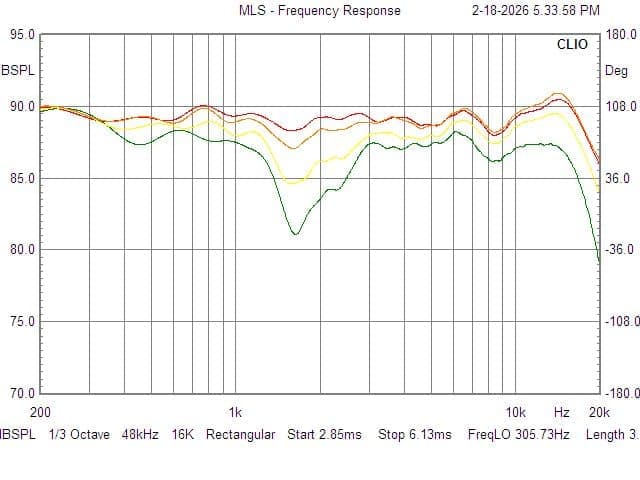
Plot 3 — Vertical Off-Axis
Vertical dispersion family. Tighter vertical pattern ensures consistent tonal balance within the listening window.
Sit in the chair. Don't stand over them.
Crossover & Impedance
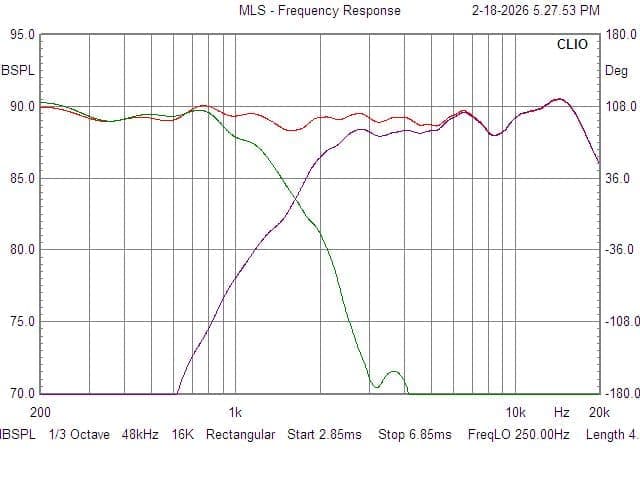
Plot 4 — Crossover
Individual driver responses showing crossover integration. Clean acoustic summation through the transition region.
Woofer and tweeter meet as one voice, not two.
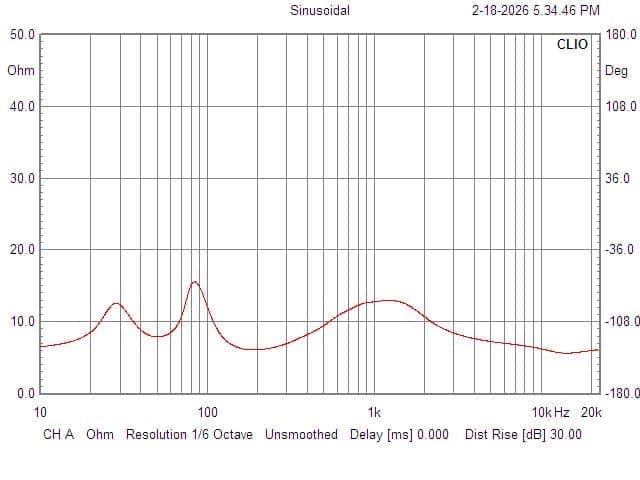
Plot 5 — Impedance
Impedance curve measured via sinusoidal sweep. Dual impedance peaks visible with minimum impedance staying above safe amplifier loading thresholds.
Easy load. Most amps will drive them without drama.
Cumulative Spectral Decay
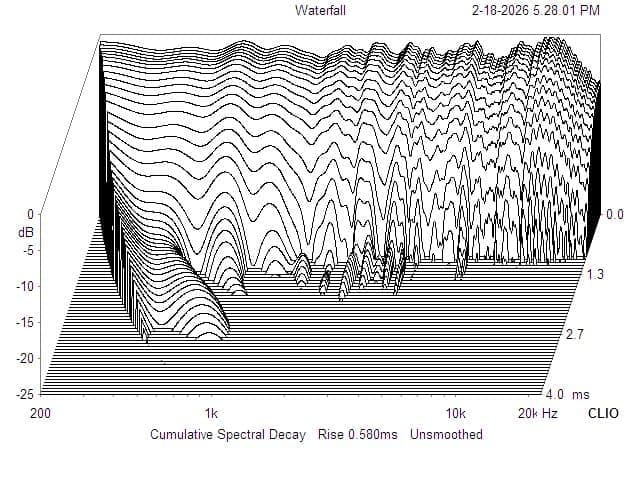
Plot 6 — Waterfall
Cumulative spectral decay (waterfall) showing energy storage and decay characteristics. Clean decay with minimal resonances — indicating well-damped cabinet and driver behavior.
Bass stops when the note stops. The box doesn't keep singing.
Estimated Full-Range Response
Estimated — Anechoic
Free-field response. Clio measurement above 200 Hz spliced onto a fourth-order Butterworth high-pass model below, with F3 = 50 Hz from the bass-reflex alignment.
Estimated — In-Room
Anechoic curve combined with a typical room transfer function — a continuous downward tilt across the spectrum (about -1 dB/octave) plus added bass gain below ~150 Hz from boundary loading — then 1/3-octave smoothed to reflect the spatial averaging of direct sound, early reflections, and reverberant field at the listening position.
On These Estimates
These curves are estimates, not direct measurements. The anechoic plot splices a fourth-order Butterworth alignment below 200 Hz onto Clio data above; the in-room plot adds a typical room transfer function for bass gain and high-frequency absorption. Full CEA2034 spinorama data — on-axis, listening window, early reflections, sound power, and directivity index — will be published once we have access to a Klippel Near-Field Scanner.
Dimensions
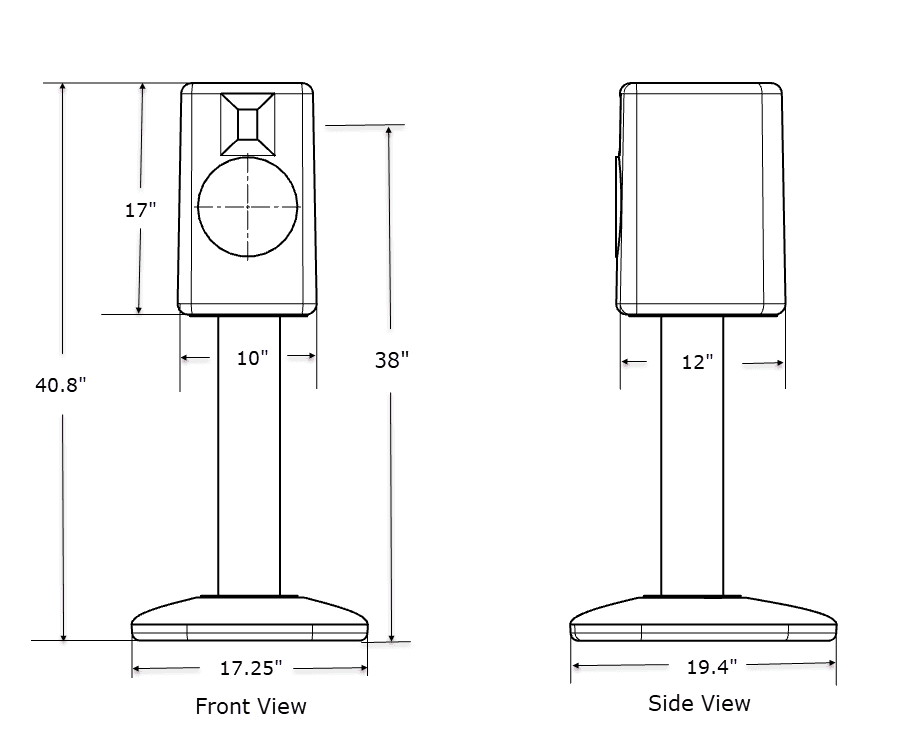
Arcus Dimensions — With Stand
Front and side views showing cabinet and stand dimensions. Overall height 40.8" on stand, cabinet 17" tall × 10" wide × 12" deep, stand base 17.25" × 19.4".
Measurements by Danny Richie · GR Research — CLIO System — Feb 2026
Hear the Difference.
These aren't specs on paper — they're engineering decisions you hear in every note.